

U.S. MS4 Needs Assessment Survey
This one-of-a-kind national survey seeks to understand municipal separate storm sewer system (MS4) sector challenges, drivers, and needs.
U.S. MS4 Needs Assessment Survey
WEF has conducted four Municipal Separate Storm Sewer System (MS4) Needs Assessment Surveys in 2018, 2020, 2022, and 2024 to better understand the challenges, priorities, and resource needs of stormwater programs across the United States. Together, the survey results provide insight into changing needs and trends across the MS4 sector, including program challenges, technical resource needs, funding, infrastructure, and resilience.
WEF’s goal is to reach as many MS4 communities (phase I, phase II, and non-traditional MS4 permitted programs) across the nation as possible while significantly representing all ten of the U.S. Environmental Protection Agency regions and surpassing the previous iteration of responses.
2024 MS4 Needs Assessment Survey Results

WEF’s fourth MS4 Needs Assessment Survey received 578 responses from Phase I and Phase II communities, nontraditional MS4s, and state departments of transportation. Data collection continued into 2025 to support geographic representation and response volume for national analysis. The results provide an updated look at MS4 program challenges, priorities, funding, capacity, technical needs, and resilience.
2022 MS4 Needs Assessment Survey Results
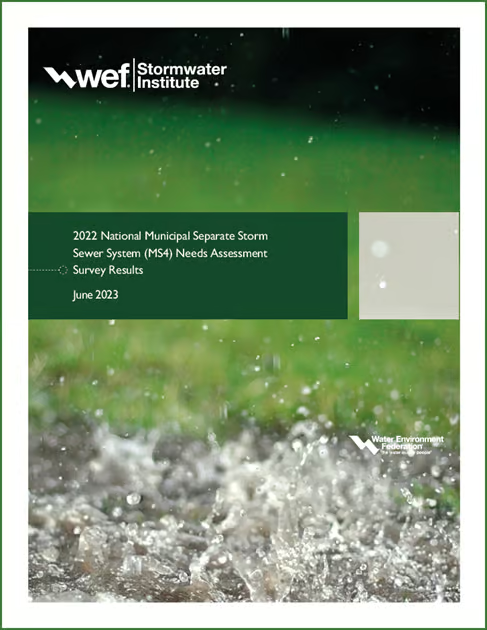
Conducted in late 2022 and early 2023, WEF’s third MS4 Needs Assessment Survey received 643 usable responses from 47 states and the District of Columbia. The results examine MS4 program challenges and technical needs, stormwater funding and investment gaps, asset management, resilience planning, and program maturity.
2020 MS4 Needs Assessment Survey Results
Conducted in late 2022 and early 2023, WEF’s third MS4 Needs Assessment Survey received 643 usable responses from 47 states and the District of Columbia. The results examine MS4 program challenges and technical needs, stormwater funding and investment gaps, asset management, resilience planning, and program maturity.
2018 MS4 Needs Assessment Survey Results
WEF’s first MS4 Needs Assessment Survey gathered responses from more than 600 MS4 permittees nationwide. The results identified common challenges and needs, including dedicated funding, infrastructure renewal and replacement, and clearer regulatory requirements.
For additional information or questions, please contact Lisa Deason at ldeason@wef.org.
Water Week 2027 | April 13-15
Join water professionals from across the nation to help advance key water policy priorities such as sustained growth in federal infrastructure investment, addressing water affordability, supporting water research and development and advancing sound science-based solutions, and making our critical infrastructure more resilient.
Where the Water Community Connects
See how WEF connects the people and ideas driving clean water and public health. Membership gives you access to benefits, resources, and a network committed to impact.