
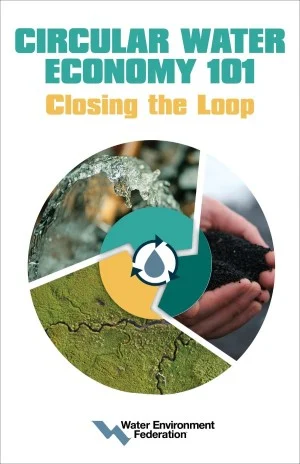
Circular Water Economy 101: Closing the Loop   

The circular water economy reimagines water as a renewable, regenerative resource—one that can be continuously recovered, reused, and reintegrated to create value across communities, industries, and ecosystems. This book provides a comprehensive exploration of this transformative approach, centered on three core strategies: Reduce, Recover, and Regenerate.

Readers will gain a clear understanding and definition of each core strategy, along with practical insights into their financial benefits, supporting technologies, and implementation frameworks. The book also highlights the importance of public outreach and stakeholder engagement in driving successful adoption.

Through real-world case studies, this resource demonstrates how circular water principles can be applied across diverse settings, offering actionable guidance for utilities, policymakers, engineers, and sustainability professionals seeking to build more resilient and efficient water systems.

Table of Contents:
Chapter 1 Circular Water Economy: An Introduction

Chapter 2 Reduce

Chapter 3 Recover

Chapter 4 Regenerate

Chapter 5 Elevate
Where the Water Community Connects

See how WEF connects the people and ideas driving clean water and public health. Membership gives you access to benefits, resources, and a network committed to impact.

Explore All Practice Areas

Biosolids Resource Recovery

Safe and sustainable: Biosolids management transforms wastewater solids into odor-controlled, pathogen-reduced agricultural products, strictly regulated for environmental safety.

Collection Systems and Conveyance

Sanitary sewers safely transport household and commercial wastewater through underground systems, improving public health and meeting modern infrastructure standards.

Government & Regulatory Affairs

Empower water professionals with knowledge and tools to influence public policy-WEF advocacy promotes awareness and engagement on key water issues.

Public Health

The water sector and its systems protect public and ecological health. Using the data that can be collected through smart water technologies provides additional insights to address complex public health issues.

Stormwater & Watershed Management

Take a comprehensive look at how all water resources, including uplands, drainage basins, wetlands, stormwater, surface water, and groundwater interact.

Water & Wastewater Treatment

More than 16,000 publicly owned water resource recovery facilities operate in the United States. Skilled engineers and operators work together to ensure new and updated facilities continue to protect public health and the environment.

Industrial Water Resources

Industries treat and reuse wastewater and process water as well as provide environmentally sustainable wastewater treatment while reducing costs and maintaining value for their businesses.

Operations

From hands-on training and leadership opportunities, such as the WEFTEC Operations Challenge, to online training, such as the Wastewater Treatment Fundamentals series, WEF provides operators with many opportunities to advance on-the-job knowledge and develop their careers.

Utility Management

To respond to myriad daily challenges faced by water and wastewater utility leaders, WEF continuously works with its members and partners to develop various management initiatives, resources, and educational, training, and networking opportunities.

Previous slide
Next slide

Advertisements

Scroll to Top
Secret Link