
Write for WE&T
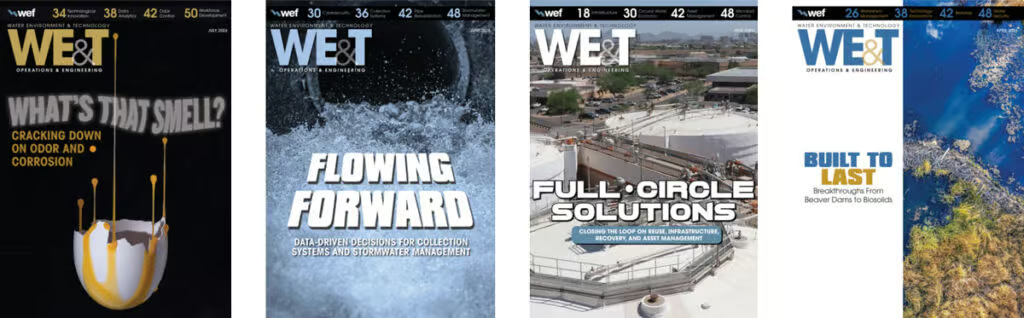
As the flagship publication of WEF, WE&T covers a wide range of water quality and municipal wastewater treatment issues from the design, engineering, and management of domestic water resource recovery facilities to watershed management and wet weather issues as well as utility management and emerging topics that concern the water sector.
WE&T welcomes all submissions.
WE&T’s annual editorial calendar focuses each issue on a set of four topics. Each issue contains three to six feature articles corresponding to these topics. Additionally, sections such as News, Research Notes, and Waterline examine in-depth topical issues of the day.
Submit an Idea
We aim to keep things simple and straightforward for our authors. Authors are highly encouraged to submit an idea rather than a completed manuscript. Ideas can be formal abstracts or outlines or just a few sentences drafted in an email. We encourage authors to reference the editorial calendar for idea due dates.
Here is what we suggest:
- In a few hundred words, describe what your article will tell readers.
- Who is the specific audience? While we strive to make all articles accessible to all, knowing which specific readers – operators, engineers, regulators, utility managers – are the intended primary audience helps.
- Imagine someone just finished reading your completed article. What are the two or three takeaway messages that this reader would share with their coworkers in the breakroom?
Full manuscripts are accepted, too. However, they may require significant editing to fit the WE&T Style.
WE&T does not accept simultaneous submissions or articles that have been previously published.
The WE&T editors review and respond to all submissions – typically within 4 to 6 weeks.
If selected, deadlines and publication dates will be agreed upon by the editors and authors. All authors must sign an author agreement for an article to be published in WE&T.
Since WE&T editors are working on feature articles several months in advance of publication, authors are encouraged to submit their proposals as far in advance of the desired publication issue as possible.
Article Writing and Editing Guidelines
WE&T strives to offer a variety of voices and writing styles in articles. At the same time, we follow some basic guidelines for consistency.
Length
Feature articles typically contain between 1500 and 2600 words. Longer articles will be edited down or published as a multipart series.
Format
Submitted articles should resemble a magazine feature rather than an academic paper.
- All articles should have a headline, as well as one or two short introductory paragraphs that hint at (but do not give away) the outcome.
- Short subheads should be used to break the article into accessible chunks of information.
- The article should have a logical flow from beginning to end, whether it is chronological, spatial, or by order of significance.
- Footnotes are not used; any references, which should be kept to a minimum, should be attributed within the text of the article.
- Information that is relevant but not central to the story — such as a list of useful resources — should be listed separately in a sidebar.
Content
Articles should be targeted to a specific audience within the water sector as well as be of interest to the general water sector audience. Articles should be informational and free from any promotional language. Specific product information should be made generic unless its inclusion is essential for the reader’s understanding.
SI units
All WEF technical periodicals use the international system for units of weights and measures. Authors submitting articles that contain English units will be asked to provide conversions.
Brief author bio
Authors should submit biographical information, including title or professional discipline, company name, office location, and company headquarters.
Professional or educational degrees, titles, and certifications are not included in the biographical information.
Artwork
Authors are encouraged to submit artwork, especially original photos, to accompany their articles. Original graphic files (photos, figures, tables, and charts) must be sent separately from text files.
Photos and figures should be:
- TIFF, JPEG, or EPS format and
- high resolution (file sizes should be at least ~1 MB)
Authors submitting photos also should provide caption and photo credit information.
Tables must be in Microsoft Word or Excel format. Charts must be accompanied by original (Excel or Word format) spreadsheet files.
Generative AI Policies
Authors/contributors/reviewers who produce content for WEF must adhere to the following generative AI policies.
- Do not use AI tools to write any part of a book proposal or manuscript.
- Do not use AI tools to create or alter figures/images for inclusion in a publication.
- Do not use AI tools to copyedit content. Our staff editors handle this task, and they take great pains to balance authors’ voices and ideas with WEF style.
- Do not use AI tools when acting as a reviewer of WEF content. We want your expertise and unique perspective to inform your feedback.
- You may use AI tools in the following ways if you are transparent about it, disclosing what tool (and version) you used and how you used it.
- Brainstorm ideas, such as an overall theme, to execute with your own original writing.
- Conduct research for your own original writing. Authors are responsible for all content in their content and should fact-check any AI-generated information to be sure it is accurate, does not inadvertently violate another’s intellectual property, and reflects their own expertise.
- Authors who fail to disclose, upon submission of content, the AI tools they used will be in violation of their author agreement, and WEF may retract their work.
WEF Publishing is dedicated to the creation and dissemination of accurate, well-sourced information in support of the water sector and the professionals who work within it. For almost 100 years, we have worked with subject-matter experts to ensure our publications are reliable, relevant, and practical.
Given the rapid development of generative artificial intelligence (AI) in the water sector, we are updating our policies to ensure we can uphold our commitment to excellence. Simply put, we believe our readers deserve engaging content that reflects the hard-earned knowledge and perspectives of people working within the sector.
While generative AI can be a useful tool in many instances, it cannot take the place of a human author. Machine writing removes the human element that makes content unique, credible, and approachable. It eliminates the direct accountability of subject-matter experts who stand behind the ideas and facts presented, and it makes it difficult to determine provenance of information. Further, human authorship is a prerequisite for copyright protection. This means we cannot put your byline on, or prevent others from using or adapting, any work that is machine-written, even if it uses your own ideas.
Publication Process
Editing ensures that articles are in the best shape for publication. Once your article is accepted, it will be assigned to a WEF editor.
Editing
Articles are edited for clarity, cohesion, substance, and style. WEF follows its own editorial style that dictates grammatical preferences and how words are treated.
For example
- Stormwater is one word, not two.
- Water resource recovery facility, not wastewater treatment plant, is the preferred term
While prospective authors are not expected to tailor their submissions to WEF style conventions, all articles are edited to conform to this style before they are published. However, WEF editors recognize that each writer has a unique writing style, and make every effort to preserve that style.
Author review
Authors always have the opportunity to review and approve changes. Once an article has been edited, it is sent back to the author for final review. Authors also may be asked to revise their articles or provide additional information.
The final draft is the author’s last opportunity for editorial input.
Layout and design
Articles are edited individually, but may require changes once the whole of the magazine is assembled. Therefore, headlines and subheads may be rewritten.
Use of photos and figures may vary.
The final draft authors receive is the editor’s best approximation of how the article will appear, but the nature of the production process is that additional small changes may be made. The editor will contact the author if any questions or significant content changes arise during production.
Other Submissions
WE&T accepts submissions of press releases and other news within the water sector. These items are published on a space-available basis.
Because of the volume of submissions received, editors cannot guarantee if or when a submission will appear in print or online. Nor can editors track where in the process a particular item may be.
Business
This section provides brief updates on contracts, promotions, new locations, and awards. Photos are encouraged. Send information and photos to biznews@wef.org. See an example.
Operator Essentials
In-depth, practical, how-to guidance for water and wastewater operators, focusing on core operational tasks, the use of emerging technologies, soft skills, and best practices for compliance, maintenance, safety, and troubleshooting. Guidance should be organized into a three-column structure that includes knowledge (introducing a concept), principles (key definitions related to the concept), and practical considerations (tips to navigate the concept). Word counts typically range from 600 to 2,000. Send ideas to Jessica Rozek at jrozek@wef.org. See an example.
Operator Ingenuity
Highlights creative, low-cost, or unconventional solutions developed by operators to solve everyday problems on the job. This section, which typically includes 500 to 1,000 words, emphasizes peer-to-peer knowledge sharing and outside-the-box thinking. It spotlights jury-rigged tools and equipment, non-standard operating parameters, and new perspectives on how operators approach their work. Send ideas to magazine@wef.org. See an example.
Projects
This section includes roughly 250-to-500-word profiles of new and notable projects throughout the water sector. They feature completed or under-construction installations and describe project goals and planning considerations, design and construction processes, and lessons learned during project delivery, focusing on key decision points and measurable outcomes. Photos highly encouraged. Send information and high-resolution photos to magazine@wef.org. See an example.
Splash Shot
A venue for high-resolution photography that captures people, infrastructure, creative outreach efforts, and other eye-catching water-sector developments. These short photo essays, which typically include a maximum of around 600 words in caption format, prioritize photography printed large across entire pages. Send high-resolution photography and information about what the photos depict to magazine@wef.org. See an example.
Viewpoint
This section is a forum for clearly argued, expert perspectives on timely issues affecting the water sector, such as commentaries on new or necessary regulations, technologies, funding programs, workforce developments, and more. Arguments should be well-supported with data and reputable sources, with an emphasis on advancing professional dialogue. Viewpoints typically range from around 500 to 1,000 words. Send ideas to magazine@wef.org. See an example.
WEF Member Spotlight
Profiles an individual WEF member, highlighting their career path, contributions to the profession, involvement with WEF, as well as hobbies, personal achievements, and life outside the water sector. Subjects should be current WEF members. If you would like to be featured in this section, please contact Michelle Kuester at mkuester@wef.org. See an example.