
Why the Guide is Necessary
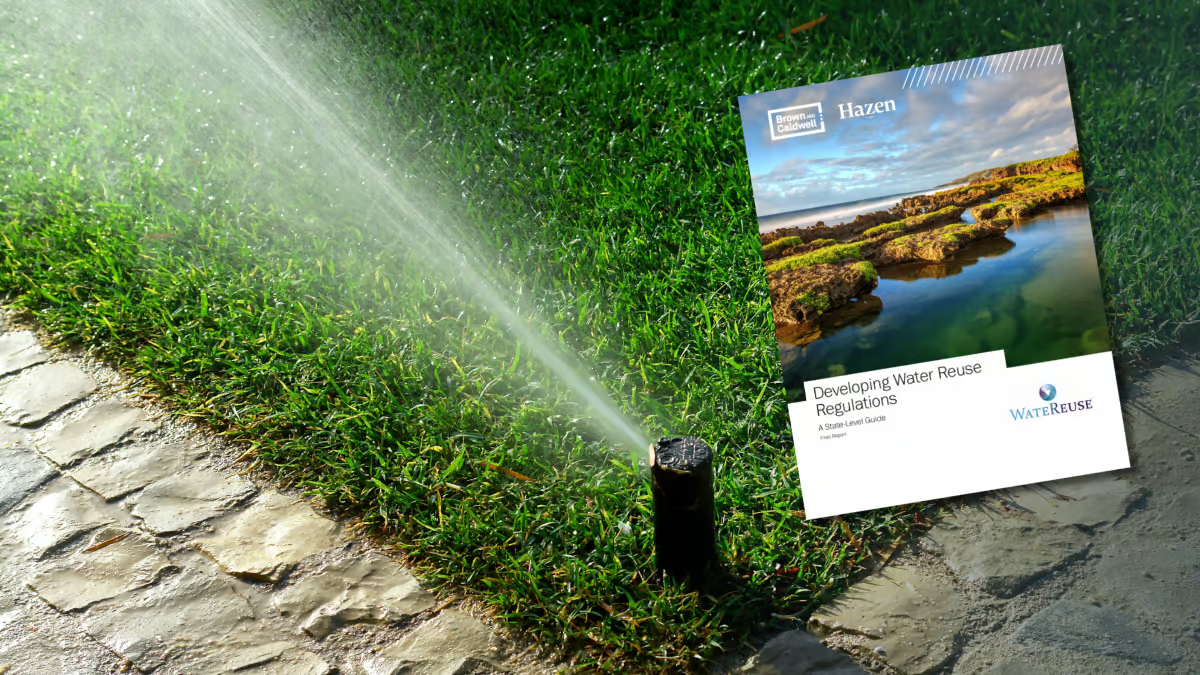
A new guide for developing state water reuse regulations has been published for utilities, regulators, and practitioners to work together and create practical regulations and governance structures to support water reuse. Water reuse is an integral part of the water sector’s ongoing transformation to a circular water economy by creating reliable, local water supplies. Highly treated municipal wastewater can be safely reused as a reliable and drought-resilient water source. It can safely be used for the irrigation of public and agricultural landscapes, environmental restoration, industrial applications, and even to bolster potable drinking water supplies. With ongoing risks of drought, planned industrial development, and pressing water quality needs, water reuse is quickly expanding throughout the nation.
The development of this guide was led by the WateReuse Association along with the Water Environment Federation, American Water Works Association, Association of Metropolitan Water Agencies, and the National Association of Clean Water Agencies. The technical team was led by Brown and Caldwell in collaboration with Hazen and Sawyer and the guide was reviewed through a technical advisory committee of utilities, regulations, and practitioners, including Dr. Zeynep Erdal – Chair of WEF’s Water Reuse Community.
The Challenge of Regulatory Uncertainty
Water reuse is unique in that there are no federal regulations governing either non-potable or potable applications. While the Clean Water Act and Safe Drinking Water Act can provide a starting point, states that want to expand adoption of reuse need to develop appropriate regulations and governance frameworks to enable the adoption of different reuse applications. Meanwhile, with numerous sources of water and potential end-uses, there are many different potential water reuse scenarios that need to be accounted for in regulations.
The U.S. Environmental Protection Agency has done the work to identify and catalog the currently available state regulations through the Regulations and End-Use Specifications Explorer (REUSExplorer) tool. While this tool has been useful in giving utilities and practitioners an understanding of the current state of practice, it is not intended to guide states looking to develop regulations for the first time. In addition to states looking to develop new regulations, states with existing regulations may need to revisit them as new non-potable end-uses are identified, interest in potable reuse grows, or if new science and other information necessitates updating regulations. Meanwhile, utilities and practitioners interested in pursuing reuse in states without practical regulatory frameworks can be saddled with uncertainty, and impactful projects can languish in the conceptual phase.
While the lack of a national regulatory structure for reuse can create challenges, a state-led process for developing and implementing regulations does create the opportunity for states to create regulations tailored to their needs and regional conditions. Different states and regions have different environmental and water supply challenges, and regulations for some reuse applications are not well suited for a one-size-fits-all approach. As water reuse adoption expands, policy frameworks can evolve and diverge as different applications become more prevalent in some states compared to others. For example, it’s easy to anticipate regulations for agricultural irrigation to be more of a focus for states that have a robust agriculture industry compared to states that do not.
Who the Resource Serves
In addition to state regulators and decisionmakers, this resource was developed primarily for utilities, practitioners, and other interested stakeholders involved in water reuse rulemaking. State rulemaking for reuse can be a collaborative process with the state environmental agencies frequently soliciting expertise from the water sector and public health experts to ensure that new regulations are practical in their design while still protective of public health and the environment.
Water reuse regulations can be complex and cover a variety of different disciplines, and this guide provides reliable information and insights about questions related to the following topics to provide a solid foundation on water reuse:
- Type of reuse application
- Public health benchmarks
- Source water characterization
- Water quality targets
- Treatment requirements
- Monitoring and reporting
- Institutional capacity
The structure of this guide takes an initially daunting process and identifies the key decision points along with information and strategies to ensure those decisions are made using sound science, and with an eye towards implementation. All of this is in service of accelerating the adoption of water reuse and ensuring the projects are designed, built, and operated with necessary safeguards while maximizing available benefits.
Advancing Collaboration and Looking Ahead
It’s important for readers to view this guide as more than just a reference document with key facts and resources. While those aspects are important, this guide also empowers regulators and key stakeholders to better collaborate and work together towards a common goal. The guide is designed for readers of varying levels of background knowledge and expertise about water reuse to establish a common set of knowledge, but more importantly puts the necessary information in the proper context to support informed discussions between stakeholders and decisionmakers.
This guide also builds off the experiences of states with successful water reuse programs so states can learn from each other. Such experiences go beyond just regulatory language but into the regulatory development process. Understanding how water reuse regulations can and should be developed is just as important as understanding the precise language that goes into a final regulation. The best regulatory structures for water reuse come from a starting point of collaboration to ensure that regulations are designed in a way to reduce barriers to innovation and adoption of reuse while retaining robust protections for public health and the environment.
Call to Action
With the publication of this regulatory guide, the next step is the hard work of implementing its lessons to develop practical, protective regulations for water reuse in states across the country. WEF is helping to lead this effort through our circular water economy initiative. Water reuse is an integral part of the circular water economy with up to $18 billion in annual value available from expanded reuse of the $47 billion in overall value from a fully implemented circular water economy. To help advance this critical component of the circular water economy, contact Congress in support of increased water reuse funding and join WEF’s Water Advocates to stay informed about future opportunities to make your voice heard.
WEF members can join this effort through our Water Reuse Community that works to share resources, experiences, and engage the water sector through workshops and other technical outreach. In addition, the Water Reuse Community has a series of active focus groups including an Upper Mississippi River Basin Focus Group that recently published a Reuse Rulemaking Roadmap for the Great Lakes and Mississippi River Basin.
WEF remains committed to working with our partner organizations in the water sector to expand water reuse opportunities through WEF’s effort to lead the transformation to a circular water economy, our events and educational programming, and through the expertise and experience of our member communities.
Justin Mattingly
Senior Advisor, Resource Recovery