
Funding, regulatory updates top list of 2026 priorities for U.S. stormwater sector
Stormwater professionals from across the United States gathered in Washington, D.C., this spring with a shared goal: strengthen how communities manage stormwater and prepare for growing risks.
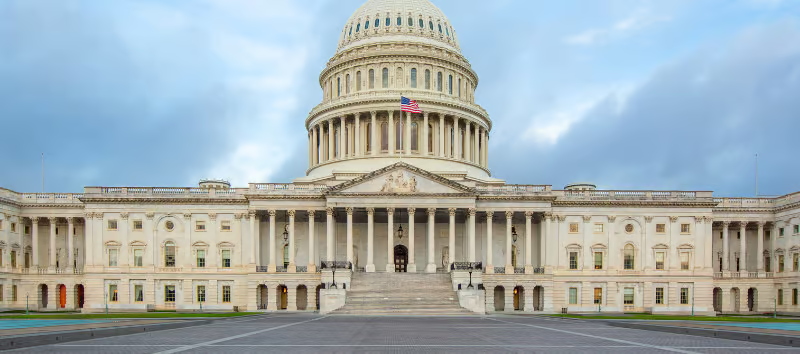
During the 2026 National Stormwater Policy Forum on April 13, participants identified the most urgent needs facing the sector today. The event, co-hosted by the Water Environment Federation and the National Municipal Stormwater Alliance, brought together utility leaders, researchers, and policy experts just ahead of the National Water Policy Fly-In.
The message was clear. Communities need stronger federal support, clearer regulations, and long-term investment to keep people safe and protect water resources.
A focused set of priorities
At the center of the discussion was a new recommendations document developed by WEF and NMSA. The document outlines what communities need from federal partners to improve stormwater programs nationwide.
The priorities focus on four key areas:
- Ensuring federal stormwater programs are fully funded and reauthorized
- Improving how funding programs are structured so they better support stormwater needs
- Expanding the Centers of Excellence for Stormwater Control Infrastructure Technologies program
- Updating federal MS4 requirements to reflect decades of real-world experience
Together, these actions are intended to help communities reduce flood risk, strengthen infrastructure, and improve water quality.
“This addresses some of the most important infrastructure challenges your communities have,” Scott Taylor, chair of the NMSA executive board, told forum attendees.
The funding gap remains a major hurdle
Even with clear priorities, one challenge continues to stand out: funding.
Stormwater programs often compete for limited resources, and existing funding levels are not keeping pace with growing needs. Leaders at the forum pointed to several federal programs that require continued or expanded investment, including support for clean water financing, stormwater grants, and U.S. Army Corps of Engineers projects.
The urgency is underscored by recent trends. In 2025 alone, the United States experienced 23 weather-related disasters that each caused more than $1 billion in damages. At the same time, key provisions of the Infrastructure Investment and Jobs Act are set to expire, creating additional uncertainty for long-term planning.
For many communities, the gap between needs and available funding continues to widen.
New data reinforces the challenge
Forum discussions were informed by WEF’s 2024 MS4 Needs Assessment Survey, which gathered input from nearly 600 stormwater professionals across the country.
The results highlight a sector under pressure:
- Many communities face aging infrastructure and increasing storm intensity
- Nearly two-thirds report annual budget gaps for stormwater programs
- Only about 30% receive supplemental funding beyond their primary budgets
The survey also revealed that many programs do not yet have long-term resilience plans or updated design standards in place. This creates additional challenges as communities work to respond to more frequent and intense storms.
Notably, aging infrastructure has now become the top driver of stormwater investment decisions, surpassing water quality concerns. Localized flooding and land development also rank among the leading factors shaping priorities.
Turning data into action
Participants used both the recommendations document and survey findings to prepare for meetings with members of Congress during the National Water Policy Fly-In.
The goal was to connect real-world data with policy decisions and communicate the scale of the challenge facing communities.
[We can focus on] becoming the utility, that from the stormwater side, we know we are,” Jamie Houle, research assistant professor in Civil and Environmental Engineering at the University of New Hampshire (Durham), and member of the MS4 Needs Assessment Survey review panel, told attendees as a closing reminder.
The path forward involves not only securing funding, but also continuing to define stormwater as a critical public service that protects both communities and the environment.
Why it matters
Stormwater management is becoming more complex as communities face heavier rainfall, aging systems, and increasing development pressures. The forum highlighted that addressing these challenges will require coordinated action across all levels of government.
With clear priorities and new data in hand, stormwater leaders are working to ensure that federal policy and funding decisions reflect the realities on the ground.
Katie Johns
Contact: Katie Johns, Director, Content & Creation and Editor-in-Chief, WE&T 703-684-2403 | kjohns@wef.org